
Home page
Last update:
3-May-2020
www.miketodd.net
©1996-2020
Mike Todd
Who am I?
This is as near an autobiography of me as you'll get! My name is Michael Todd, although most people call me Mike, and one or two are allowed to call me Mickey. And, no, I was never married to Elizabeth Taylor!
My Family
 I was born in Salmon
Street, South Shields, in the north east of England, in 1951. My
father, Robert, was a butcher and musician.
I was born in Salmon
Street, South Shields, in the north east of England, in 1951. My
father, Robert, was a butcher and musician.
He served his time in the Second World War with the British Expeditionary Force in Holland, and after the war he started his own business at 1½ Woodbine Street. We lived in Salmon Street, but later moved to Marsden Road, and my father's business moved to Ocean Road in a partnership as "Todd & Stewart".
Eventually the partnership failed, and we moved to above two shops, opposite the Ship Inn. My father continued his business there, renting out the smaller shop as a greengrocer's.
My father's love of music came from my grandfather, James Todd, who was a professional musician and director of the orchestra at the Queen's Theatre in South Shields. I was steeped in music from an early age, and I often went on Sunday mornings with my father to Dr Emanuel Anderson's house in Sunderland Road where a small group would play string chamber music. It was here that I met (and played for) Yehudi Menhuin and John Lill!
 My mother, Minnie, was with the WAAF during the war, and a very busy
butcher's wife after that. Her father was a grocery store manager, eventually becoming area manager for a chain of grocery stores in the south,
based in Bedford.
My mother, Minnie, was with the WAAF during the war, and a very busy
butcher's wife after that. Her father was a grocery store manager, eventually becoming area manager for a chain of grocery stores in the south,
based in Bedford.
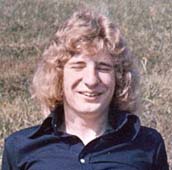
I had a brother, James, who was 4 years younger than me and quite different in personality. Sadly, he died in a car accident at the age of 17 - the picture on the left was taken only a couple of weeks before the accident in 1972.
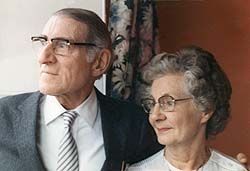
In 1985, my parents moved down to Welwyn Garden City, where I had lived from the mid 70s. The picture above was taken just before they moved. After a long illness, my father died in 1990 - my mother died in March 1999.
School and Work
James and I both went to the South Shields
Grammar Technical School for Boys. James joined in 1968, having passed his 13-plus,
and I was there between 1962 and 1969.
It was at the school this I got my hands on a computer for the first time when, in 1966, it acquired an old Ferranti Pegasus - only the second school in the country to have its own computer, and the first to have a working one. It was full of valves, took up a whole classroom (and more!) and needed its own power alternator to keep it going.
I left school the same week that Armstrong walked on the moon, heading towards my childhood ambition of becoming a television cameraman. I joined the BBC in September 1969 on a course at their Wood Norton Hall training centre, just outside Evesham, in Warwickshire. After a spell as a trainee, I became a cameraman for BBC Television working on a wide range of programmes. As part of the training, I spent time on TV sound and on "electronic effects" (including very brief spells on Doctor Who and Top of the Pops), and did a lot of swinging and driving of camera cranes.
Although most of my friends from school had gone to university, I had not. However I put this right just after the Open University was founded. There, I studied a broad range of subjects (from the physics of space and time, to the history of music) - however, my "major" was with in psychology and I was able to become a member of the British Psychological Society.
In the mid-70s, I decided that the pictures were better on the radio, and so were the people. So I moved to BBC Radio, based in Broadcasting House, and became a Technical Operator in the main Control Room. Here we switched audio circuits, tested outside-broadcast lines, managed the transmission distribution, did the technical operation of all of the BBC's national radio networks and balanced DJ programmes.
We got involved in many big events, and during that time I worked as the International Technical Co-ordinator at Broadcasting House for the Pope's pastoral visit to the UK in 1982, and during the wedding of Charles and Diana I worked with a colleague in the Control Room setting up and feeding the radio and television sound to the entire world.
I was promoted to supervisor and, following a major reorganisation within BBC Radio, I was appointed to be one of the newly-formed team of Broadcast Duty Managers in 1988, and took up the post in early 1989.
This new job was an interesting one in many ways. We were put together as a team of five, providing "operational management" cover 24 hours a day, 7 days a week. The role was to make sure that BBC Radio kept broadcasting no matter what - from technical faults to terrorist attacks, from DJs turning up late to war.
The BDMs were the central co-ordination point for just about any emergency, from internal problems to a national emergency, and were the government's key operational point of contact. And when the rest of the BBC went home, the BDMs managed BBC Radio's technical staff and studio facilities.
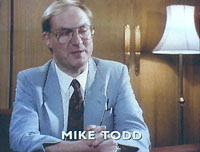 At one point I was "invited" to be BBC Radio's spokesman
on the Greenwich Time Signal in a tiny
part of a major BBC2 TV programme for Arena (called Radio Nights).
As it happens, it was very tongue-in-cheek and, at the end of a long filming
session, they used only the most embarrassing bit!
At one point I was "invited" to be BBC Radio's spokesman
on the Greenwich Time Signal in a tiny
part of a major BBC2 TV programme for Arena (called Radio Nights).
As it happens, it was very tongue-in-cheek and, at the end of a long filming
session, they used only the most embarrassing bit!
Each of the Broadcast Duty Managers had his own specialisation - mine was emergency & contingency planning. Whether it's local emergencies, civil emergencies or national emergencies, the BBC has an important role to play, and I've done some interesting training courses as a result (but if I told you about them I'd have to shoot you!)
In 1999 I was part of the BBC's team setting up the contingency arrangements to see the BBC and the British Government through whatever Y2K would present us with. And where did I spend the 2000 New Year? In a nuclear bunker, helping lead a small team ... "just in case".
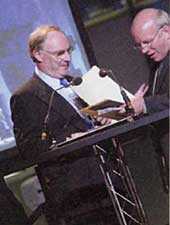 In
December, 2003, the Broadcast Duty Managers were awarded BBC Radio &
Music's highest honour - the Award for Outstanding Contribution to Radio
and Music. I accepted the award from the then Director General, Greg Dyke (see photo on the right) at
at the Radio & Music Festival dinner at the Science Museum in London.
In
December, 2003, the Broadcast Duty Managers were awarded BBC Radio &
Music's highest honour - the Award for Outstanding Contribution to Radio
and Music. I accepted the award from the then Director General, Greg Dyke (see photo on the right) at
at the Radio & Music Festival dinner at the Science Museum in London.
The start of the 21st century saw massive changes in BBC Radio. The original "old" Broadcasting House was stripped out and almost rebuilt on the inside, and was to become the core of BBC Radio. Other buildings were demolished to make way for the New Broadcasting House, which was to house BBC News, World Service and more.
As I approached my mid-50s and with a very unpleasant management culture, plus the dawn of these massive changes, the options were to stay for a further few years and fight it all or to leave - so, at the age of 54 I left the BBC after nearly 36 years (the last 16 of which were as Broadcast Duty Manager). I never did see the completion of the new buildings.
Having been born and brought up in the North East of England, I decided to move back there at the end of November, 2006. My initial plan was to move close to South Shields, where I still have family, but through an odd set of circumstances I ended up moving to Rothbury- a lovely, if somewhat remote, small town on the edge of the Northumberland National Park.
Me and computers
My first introduction to computers was at school, but as part of my Open
University course I used a teletype terminal at the local college to run
programmes on the OU's main computer system, and this stoked my interest.
In 1978 I bought one of the first Commodore PETs in the UK (it cost £695) - serial number 1000013. Through it I learned a great deal more about computing, and soon joined IPUG (the Independent PET User Group, later to become ICPUG, Independent Commodore Products User Group, as Commodore introduced their newer machines). I wrote for their bi-monthly journal, and then became Vice-Chairman. Later, I became Chairman for a short while, and saw the incorporation of the group as a "cooperative", but trying to do this and have a difficult shift job proved too difficult, and I had to stand down.
While I was writing, I investigated just how Commodore's floppy disk technology worked and unwittingly became something of an "expert" on it (even people in Commodore UK contacted me to find out how it worked!). As a result, in 1984 I was invited to a computer Summer School at Brandon University, Manitoba, to talk about Commodore disk drives. This was about the time that the Commodore-64 was at its most popular, and the 1541 disk drive the height of the technology.
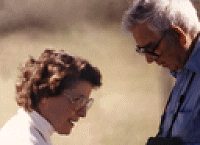 This Summer School was very significant because there I met Commodore
"guru", Jim Butterfield, who I'd corresponded with but never
met. I also met a Texas schoolteacher, Betty Clay and her husband, Richard.
Betty was in my classes and when I was invited to go the following week
to Lincoln, Illinois, to give classes on machine code programming, there
she was again.
This Summer School was very significant because there I met Commodore
"guru", Jim Butterfield, who I'd corresponded with but never
met. I also met a Texas schoolteacher, Betty Clay and her husband, Richard.
Betty was in my classes and when I was invited to go the following week
to Lincoln, Illinois, to give classes on machine code programming, there
she was again.
I joined CompuServe, one of the earliest "social media" sites very shortly afterwards, and was using email from 1985 to keep in touch with Betty and others. We kept in touch ever since, and I've been privileged to visit her and her family several times in Arlington, Texas, and it is through Betty and her family that my love affair with the USA has been nurtured.
Sadly, Betty passed away in February, 2019. I wasn't able to attend the funeral, but was pleased to be able to visit the family later in the year, and see Betty's new-born grandson.
After that Summer School, along came Commodore's Amiga. While I was still Vice Chairman of ICPUG, I remember being taken to lunch by Commodore and being told, in the strictest of confidence, of their acquisition of this brand new technology. Just what did we think it should be used for? The sky, supposedly, was the limit.
Needless to say I got an Amiga, and learnt and wrote about it over the years, becoming very attached to the superb technology. After a while I became UK editor of the Canadian Transactor for the Amiga, and then the overall editor when the Canadian magazine closed, editing and "typeseting" the magazine on an Amiga. It was a labour of love - I wasn't paid for the work, and it was all done in my spare time - but eventually the magazine folded.
My attachment to the Amiga lasted for many years, but I was using PCs at work and I began to feel a need to have access to a PC at home - so I got a Texas Travelmate laptop. Whilst I was visiting Betty in Texas I decided to buy a CDROM drive for the laptop and very quickly got hooked on the reference technology (particularly DeLorme's Street Atlas program) that this gave access to. The limited range of CDROMs for the Amiga (despite its stunning abilities), and the wealth of material for the PC soon had me reconsidering my allegiance. Very reluctantly, I abandoned the Amiga for the PC, and at the same time gave up writing.
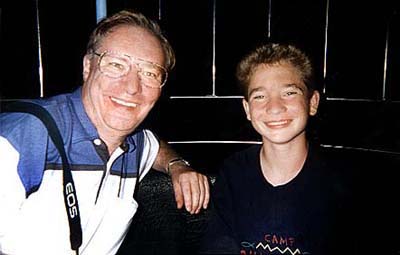
But I'm pleased to say that I never abandoned my friends in the US. I would visit whenever I could, and have had some terrific times with Betty and her late husband, Richard. Betty's daughter often "lent" me her son, Bryan - we've had great times, including days out taking photos (we're both keen photographers), at an airshow in Fort Worth, at Six Flags Over Texas and the Texas State Fair (that's me and Bryan on the right, taken in 1998). There is no doubt that a theme park is far better enjoyed with a youngster by your side - you can make a fool of yourself with impunity!
After my father died, in 1990, I was able to take my mother to the US. We visited Betty in Texas a number of times, with side trips to Florida, Arizona and Oklahoma. In 1997 the two of us went with my cousin Ginia (on my father's side of the family), to stay in rented houses in Florida, a trip we repeated several times. Sadly, my mother passed away in March, 1999, after a short but difficult illness, but Ginia and I continued to take our trips to Florida.
We discovered a wonderful house in Englewood, Florida, and rented it for a couple of years. Then one day I had to attend a forum at the Emergency plannign College in Easingwold, Yorkshire. By an amazing coincidence the owner of this wonderful house was giving a presentation. He admitted that he had taken the house off the rental market but when, in 2003, I took a sabatical from the BBC I was able to spend 8 weeks in the US seven of them "looking after" this house in Florida. I contined to visit the house for a number of years until it was sold.
Ginia and I, plus another cousin, Heather, went back to the same area but in different houses, but when Ginia passed away, the trips stopped.
Hobbies and Interests
Through a friendship with a well-known broadcaster I was encouraged to
write a novel in the 90s. It was a difficult project as it dealt with
child abuse and stereotypes. I made fair progress until the middle of
1999 when a series of computer disasters caused the manuscript to be lost
- despite having backups! Maybe I'll start it again, I don't know.
I also love to play the piano. I started to learn when I was about 4 years old, and got up to Grade 7 with the Associated Board (studied to Grade 8 but never took the exams), but these days I cannot claim to be anywhere near as good. Where I now live is big enough for a grand piano, but I made do with a Challen upright and a Yamaha Clavinova - but in 2019 I fulfilled my dream of having a brand new grand!
These days I run a number of Web sites.
This one is a personal site, reflecting my own interests - in particular, it reflects my long-standing love of America. It isn't updated very often these days, but still has something like a million hits a year. Pages on the site have been quoted in various publications (including in Lord Melvin Bragg's book, The Adventure of English), copied or quoted online as reference sources, and they even feature in at least two university theses.
The second is one for those who went to my old school (South Shields Grammar-Technical School for Boys) and contains over 500 old school photos. In around 2003 the then Head, Ian Tunnicliffe, allowed me access to the school's archives of old photos and early admisison records. A couple of years later, more old records were uncovered, and I started a process of digitising and indexing admissions from the school's founding in 1885 as the High School for Boys.As of November, 2015, these records are now online, and include the military history of many of those who served during the world wars.
At the start of 2015 I also took over the running of the Rothbury web site, which was relaunched in 2016 with a new design.
I also designed and now maintain a site for Over The Bridges the church/community magazine for the Coquet Valley, and I designed and managed a site for Armstrong Hall church in Thropton which I have now closed due to serious issues with those who run the church.
And now ...
For 14 years I lived on my own in a 3-bedroom house in Welwyn
Garden City, about 30 miles north of London, where I could sit at my computer
and look out over the local grass airstrip and across the valley into
English countryside.
But in November, 2006, I was still able to look across a valley. This time it is the Coquet valley in Rothbury - and instead of small planes and helicopters on the local airstrip, I now see low flying RAF jets passing by the window every now and again. Sadly this view has been destroyed by the building of a new estate, with houses that were simply thrown up with little thought to the overall scale of the area.
Life in Rothbury has proved to be better than I expected, with lots of new friends and interests. Perhaps the most significant (and unexpected) of these new interests was my decision to start learning the Northumbrian Pipes through the inspirattion of a talented, and then only 11-year-old, piper.
Sadly, I eventually had to admit defeat with the Pipes. Trying to get my fingers to work so differently to the piano fingering, ingrained in me since I was 4, was just too difficult. And the arthritis in my fingers didn't help.
So I spend time working on my old school's archives, being a bit of a "Mr Fixit" for friends and neighbours, working on numerous projects, working on my web sites and enjoying the company of some very special friends.
But the chance move to Rothbury revealed a whole host of coincidences, not least of which was that my mother's distant famiily (the Hindhaughs) had come from the area.
I was browsing in Appleby's bookshop in Morpeth in my first few months in Rothbury and spotted a second-hand reprint of "Upper Coquetdale", a book written by David Dippie Dixon in 1903. For reasons I never fully understood I was drawn to it, and its marked price of £1.50 made it irresistible. It turned out to be £150! But I still bought it, only to discover David Dippie Dixon had married a second cousin of mine.
And from an upstairs window I used to be able to see the spot where, in 1843, a distant cousin killed a man and was sent to the colonies.
In many ways, I feel as though I've come home.